Why Do I Still Have Loose Skin After a Facelift? Causes & What to Expect
You expected smoother, firmer skin after your facelift, so seeing some looseness in the mirror weeks later can feel unsettling. Loose skin after facelift is more common in the early weeks than most patients expect, and it does not always signal a problem with the surgery itself.
At Dr. Zamir Paez’s Dubai practice, patients are guided through each stage of facelift recovery so they understand which changes are expected and when further evaluation may be needed.
This guide covers why loose skin after facelift surgery happens, how the healing timeline unfolds, and what you can do to support the best possible outcome.
Is Loose Skin After a Facelift Normal?
Yes, in most cases. Right after surgery, the face is swollen, tissues are still settling, and the skin has not yet re-draped over its new underlying structure.
It is common to look in the mirror at two or three weeks and wonder if the results were worth it, only to see the face continue to refine over the following months. Some residual loose skin after facelift in the first few weeks is a normal part of the facelift healing stages, not a sign that the procedure has failed.
Quick takeaway: Early looseness does not necessarily represent your final facelift outcome.
Why You May Still Have Loose Skin?
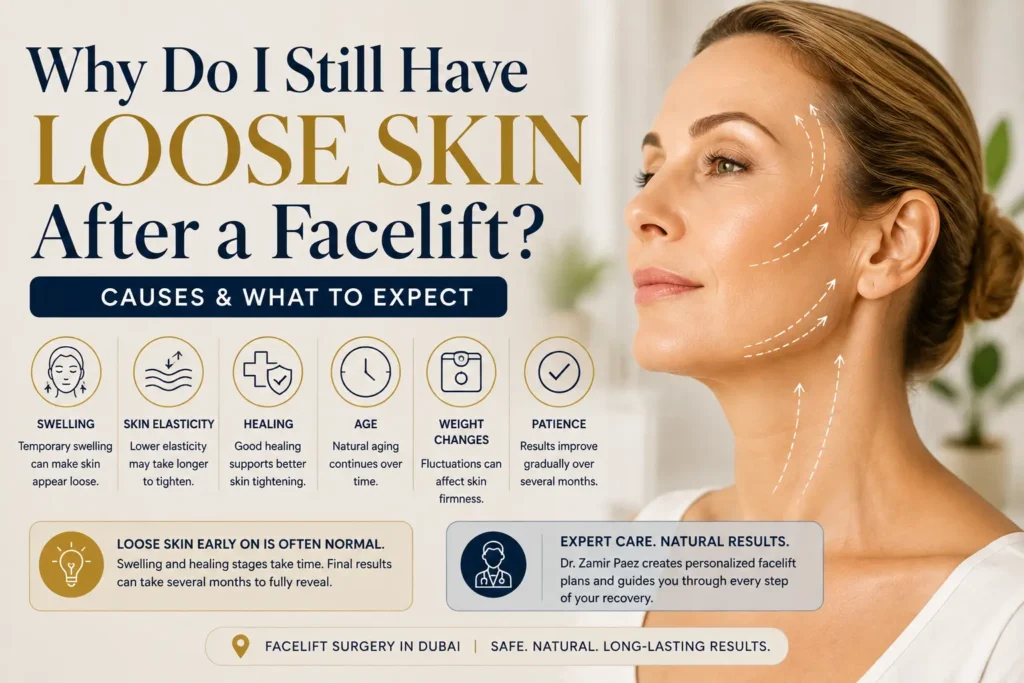
There are several factors that overlap and affect the speed and the extent of skin tightening following surgery. Each one helps you to set a realistic expectation for how long it takes to get your facelift done.
Swelling
In the first weeks, the most common cause of loose skin is facelift swelling. The skin may appear sloppy around the jawline, cheeks and neck, concealing the true contour of your lift even though the tissue is properly repositioned. Most swelling around the face will happen in the first week and slowly recede for the next month, though some mild swelling may persist for months.
Dr. Paez’s recovery guidelines suggest that patients see a gradual improvement over the next few weeks, and for some patients, the recovery may take up to 4 to 12 weeks or longer.
Skin elasticity
Skin elasticity plays a major role in how a facelift settles. Skin with better elasticity may adapt more readily to the repositioned contours, while skin affected by age, sun exposure, or reduced collagen may take longer to settle.
Healing
Each patient’s path through the facelift healing stages varies. Smoking, certain medications, and poor nutrition can all inhibit healing and slow down the final tighten. Paying attention to your post-facelift recommendations will provide your skin with the ideal environment for a fast and effective recovery.
Age
Aging does not pause the moment you leave the operating room. While a facelift will reset the clock on sagging skin, there is continual collagen loss that will cause the skin to change over the years. When loose skin comes up years after a well-done facelift, this typically represents the normal aging of the face, rather than anything wrong with the initial facelift.
Weight changes
Like any surgery, a facelift can cause significant weight gain or weight loss, which will stretch or loosen the skin without the surgery. Maintaining a relatively steady weight in the months after surgery helps preserve the results.
How Long Does it Take for Skin to Tighten?
There is no single facelift results timeline that applies to everyone.
Most patients see initial swelling resolve within two to three weeks, with visible improvement continuing for three to six months. Deeper tissue settling and final facelift skin tightening can continue for up to a year, as scar tissue matures.
Patience during facelift recovery is essential, since results at the one-month mark are not your final results. Dr. Paez’s guidance indicates that complete recovery may take four to 12 weeks or longer.
Final results are generally assessed only after sufficient time has passed for postoperative swelling and tissue changes to settle. Some subtle changes can continue beyond the early recovery period.
When is Loose Skin a Concern?
Persistent or worsening looseness deserves assessment when:
- The skin appears increasingly loose rather than gradually improving.
- There is a significant asymmetry that does not settle.
- A previously improved area develops noticeable recurrent sagging unusually early.
- There is increasing redness, warmth, drainage, severe pain, or other signs of a possible complication.
- You remain concerned after reaching the expected recovery period.
These are not typical parts of the facelift results timeline and should be discussed with your surgeon rather than left to resolve on their own.
How Dr. Zamir Paez Evaluates Facelift Results?
The goal is to determine whether what appears to be loose skin after facelift is actually residual swelling, normal tissue settling, skin-quality limitations, or a result that may require further treatment.
Dr. Zamir Paez assesses facelift outcomes over a series of follow-up visits rather than a single snapshot, tracking swelling reduction and scar maturation at each stage. Because his approach targets the deeper muscle and support layers rather than the skin alone, most facelift Dubai patients see a stable, natural-looking facelift skin tightening pattern rather than skin that loosens again over time.
Can Additional Treatments Improve Skin Tightness?
For patients who want extra refinement, energy-based skin tightening technology such as Renuvion can be used alongside or after a facelift to further contract the skin and support a smoother result.
However, treatment should not be rushed during early facelift recovery. These treatments work best as a complement to surgery rather than a replacement for it, since they cannot address the bigger structural changes a facelift corrects.
Tips to Support Better Healing
Good facelift aftercare can help your recovery progress smoothly.
- Keep your head elevated to reduce facelift swelling in the first two weeks
- Avoid strenuous activity and heavy lifting for at least four weeks
- Protect healing skin from direct sun exposure
- Stay well hydrated and eat a protein-rich diet to support tissue repair
- Follow every facelift aftercare instruction from your surgical team, including incision care and when to resume skincare products
Dr. Paez specifically recommends head elevation, activity restrictions, appropriate skincare, and follow-up monitoring as part of postoperative care.
When Should You Contact Your Surgeon?
Reach out promptly if you notice sudden swelling on one side only, increasing pain rather than gradual improvement, fever, drainage, or any concern about how your incisions are healing.
Follow-up appointments are also the right time to ask about your individual facelift results timeline and whether your healing is progressing as expected.
Even when there are no obvious complications, contact your surgeon if you are concerned about loose skin after facelift surgery. A professional assessment can provide reassurance or identify whether additional monitoring is appropriate.
Why Choose Dr. Zamir Paez for Natural-Looking Facelift Results in Dubai?
For patients considering a facelift in Dubai, choosing an experienced surgeon is just as important as understanding the procedure itself. With a wealth of experience in aesthetic and reconstructive surgery, Dr. Zamir Paez brings an individual perspective that focuses on refining facial contours while preserving natural proportions. His focus is not simply on tightening the skin, but on creating balanced results that complement each patient’s facial structure and aesthetic goals.
Dr. Zamir Paez, a trusted choice for patients seeking facial rejuvenation in Dubai
|
5,000 successful procedures |
International experience – Latin America & UAE |
Individualized treatment planning |
Natural facial harmony |
Is Facelift in Dubai right for you? Meet Dr. Zamir Paez
Loose skin in the weeks after a facelift is usually part of the normal healing process, not a sign that something has gone wrong. With realistic expectations, good facelift aftercare, and support from an experienced surgeon, most patients see their results continue to refine for months after surgery.
If you are researching facelift Dubai options or have questions about your own facelift recovery, Dr. Zamir Paez offers personalized consultations to help you understand what to expect at every stage.
FAQs - Frequently Asked Questions
It is normal for some looseness to occur temporarily as swelling improves and tissues settle. If laxity persists or worsens over time, your surgeon should evaluate this.
Skin gradually adjusts during recovery. Several weeks may be needed to fully appreciate many changes; several months may be needed for the final appearance to settle.
Yes. Swelling from facelift may temporarily cause some skin areas to look uneven, thickened or flabby.
Massage should only be performed if specifically recommended by your surgeon. It may support certain aspects of recovery but should not be expected to tighten significant skin laxity.
It can improve if the apparent looseness is related to swelling or healing. Persistent structural laxity may require assessment to determine whether another treatment is appropriate.
The results vary according to individual health; the final results are evaluated when swelling resolves and tissue settles, usually several months after surgery.
If you experience severe pain, worsening swelling, redness, drainage, fever, wound concerns, or persistent concerns about your recovery or appearance, contact Dr. Zamir Paez immediately.
Dr. Zamir Páez
About the Author
Dr. Zamir Páez
Board-Certified Plastic, Reconstructive & Aesthetic Surgeon
- Internationally Certified Plastic Surgeon
- Specialist in Advanced Body Contouring & Facial Aesthetics
- Practicing in Colombia & Dubai
- Founder of BodyCraft Academy
Dr. Zamir Páez is an internationally recognized plastic, reconstructive, and aesthetic surgeon known for delivering natural-looking results through advanced surgical techniques and personalized patient care. With over a decade of experience, he specializes in body contouring, mommy makeover procedures, breast surgery, rhinoplasty, facial rejuvenation, and HD liposculpture for patients across the Middle East and internationally.
Internationally trained at renowned institutions including The Royal Melbourne Hospital in Australia, Dr. Zamir combines surgical precision, innovation, and artistic balance to create refined aesthetic outcomes tailored to each patient. He is also the co-founder of BodyCraft Academy, where he contributes to the global education and training of plastic surgeons.
Medical Disclaimer
This article is intended for informational and educational purposes only and should not be considered medical advice, diagnosis, or treatment. Always consult a qualified healthcare professional regarding any medical or aesthetic concerns before undergoing any procedure.
Medically reviewed by Dr. Zamir Páez, Board-Certified Plastic, Reconstructive & Aesthetic Surgeon.
